


R.J. Carter has released the first official video single from his forthcoming album, Another Second Chapter, with a lyric video for “The Boy I Told Goodbye.”
Why "Citizen Vigilante" Strikes a Nerve
FTC Statement: Reviewers are frequently provided by the publisher/production company with a copy of the material being reviewed.The opinions published are solely those of the respective reviewers and may not reflect the opinions of CriticalBlast.com or its management.
As an Amazon Associate, we earn from qualifying purchases. (This is a legal requirement, as apparently some sites advertise for Amazon for free. Yes, that's sarcasm.)
Submitted by Raven Oweiner on Thu, 07/16/2026 - 05:17
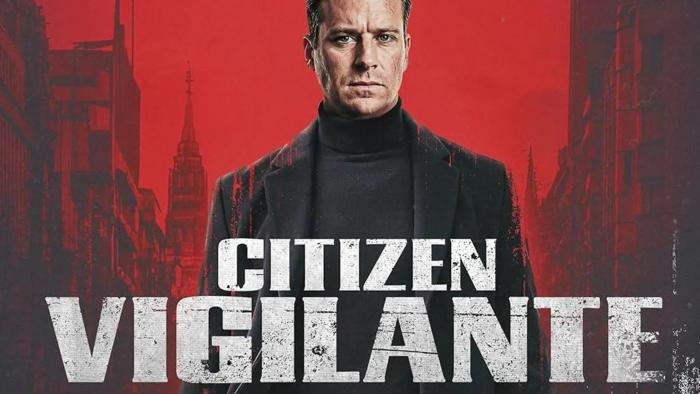
There are movies people dislike.
Then there are movies people seem determined to prevent anyone else from watching.
Citizen Vigilante has managed to become the second kind.
Uwe Boll's latest provocation stars Armie Hammer as Sanders, an American living in Europe who becomes convinced that the institutions surrounding him are either unable or unwilling to protect ordinary citizens. He responds by taking justice into his own hands, targeting criminals while transforming himself into a social-media phenomenon.
The film is violent, angry, blunt and about as subtle as a fist through a windshield.
I also liked it.
Not because I believe private citizens should begin roaming the streets and dispensing death sentences. Not because I agree with every political implication Boll packs into the film. And certainly not because Citizen Vigilante presents a realistic solution to Europe's social problems.
I liked it because it is willing to acknowledge that those problems exist.
The Movie Nobody Is Supposed to Like
Most of the criticism surrounding Citizen Vigilante has focused less on how the film is made than on what critics believe it represents.
Germany's ratings organization declined to classify the movie, effectively preventing a conventional theatrical or home-video release there. The decision reportedly concerned its extreme violence and the danger that its imagery could encourage hostility toward immigrants. When Elon Musk later promoted the film on X, the controversy expanded far beyond the audience Boll's modest production might otherwise have reached.
Some critics have described the movie as racist, anti-immigrant or even potentially dangerous. Wired focused heavily on the film's embrace by white supremacists and far-right activists, treating their enthusiasm as evidence of what the movie represents.
That association is ugly. It is also not, by itself, an argument against the movie.
Terrible people can like a film without acquiring ownership of it. Criminals have admired The Godfather. Authoritarians have quoted 1984. Political extremists have adopted songs, symbols and stories whose creators wanted nothing to do with them.
An audience's reaction can tell us something about a work of art.
It cannot be allowed to tell us everything.
Europe Is Not Imagining Its Crisis
The central fear driving Citizen Vigilante is that European governments have lost control of immigration, public order and the consequences of their own policies.
That belief is frequently dismissed as paranoia or prejudice.
Sometimes it certainly is prejudice.
But it is not entirely imaginary.
European countries have spent years struggling with large migration flows, asylum backlogs, integration difficulties, radicalization, organized crime and public anxiety over whether political leaders are willing to discuss any of those subjects honestly. Eurostat's asylum data document the extraordinary scale and persistence of migration pressure across the European Union, even if those numbers cannot tell us what any individual migrant will do after arriving.
That distinction matters.
Most immigrants are not criminals.
Most refugees are not terrorists.
A civilized society should never treat innocent people as guilty because of their nationality, religion or legal status.
But a civilized society also has a duty to protect its citizens, enforce its laws and confront serious crimes without pretending that acknowledging an offender's background is itself an act of hatred.
Citizen Vigilante occupies the space created when people stop believing their leaders can manage both responsibilities at once.
Its popularity is not proof that audiences want death squads.
It is evidence that many no longer trust the official assurances they are being given.
Boll Made the Film Angry
Uwe Boll has never been known for restraint.
He is confrontational in interviews, combative with critics and seemingly incapable of approaching a controversial subject without kicking the door off its hinges first.
That personality is all over Citizen Vigilante.
This does not feel like a detached filmmaker carefully examining both sides of a policy debate. It feels like a man who has been watching European politics, reading crime reports and shouting at his television until somebody finally handed him a camera.
Boll has openly described the film's subject as serious and real. In responding to reports that Hammer was distressed by the finished movie, he insisted that the actor understood the material and that the two had enjoyed working together. Boll told TheWrap that Hammer knew the film they were making and rejected the idea that its themes somehow appeared only after production.
I find Boll's position more convincing.
An actor can regret a movie.
He can dislike its reception.
He can discover that a performance has acquired a political meaning he never intended.
But Citizen Vigilante is not a subtle drama whose ideological implications were hidden in the editing room. Its title is Citizen Vigilante. Its protagonist hunts criminals because he believes the law has failed. Its entire narrative is built around rage at unchecked violence and institutional cowardice.
Whatever else Hammer may have believed he was making, it could not have been a romantic comedy.
Hammer's Retreat Is Almost Too Perfect
Reports that Armie Hammer later regarded the film as hateful or repulsive have become central to the publicity surrounding it.
Perhaps that reaction is sincere.
Perhaps he saw the final cut and concluded that Boll had crossed a line.
Perhaps he was alarmed by the people celebrating it.
Or perhaps an actor attempting to rebuild his career discovered that starring in Europe's most politically radioactive action movie was not the safest route back into polite Hollywood society.
Only Hammer knows.
But his retreat from the movie unintentionally reinforces its argument.
Citizen Vigilante depicts a society in which respectable institutions refuse to confront dangerous realities because doing so carries too high a social cost. Then, when the film itself became controversial, one of its most prominent participants reportedly stepped away from it because association with its message had become too costly.
The movie's central accusation and its behind-the-scenes controversy began to mirror one another.
You could not have scripted better publicity.
This Is Not a Policy Proposal
The easiest way to attack Citizen Vigilante is to treat it as though Boll has submitted a legislative program.
He has not.
This is an exploitation thriller.
It operates through exaggeration, rage, fantasy and cathartic violence. Nobody watches Death Wish for a nuanced municipal-crime strategy. Nobody watches Dirty Harry to study constitutionally sound police procedures. Nobody mistakes John Wick for a serious proposal about criminal-justice reform.
Popular entertainment frequently takes a recognizable fear and removes every legal, moral and practical restraint from it.
That is part of what fantasy does.
Sanders is appealing not because every act he commits is defensible, but because he possesses the agency that many citizens feel they have lost. He sees something wrong. He names it without euphemism. He acts while everyone around him explains why nothing can be done.
The fantasy is not merely killing criminals.
The fantasy is escaping helplessness.
The Film's Critics Are Proving Its Point
There are legitimate criticisms to make of Citizen Vigilante.
Its politics are blunt. Its villains can feel constructed to provoke rather than persuade. Its violence is excessive. Boll sometimes substitutes anger for analysis and shock for characterization.
But many of the most furious responses do not seriously engage with any of that.
They simply declare the film unacceptable.
That is precisely why it has found an audience.
When viewers suspect that an entire subject has been declared off-limits, the movie willing to address it gains power far beyond its artistic quality. When critics respond to troubling questions by denouncing the people asking them, they do not make the questions disappear.
They make the forbidden answer more attractive.
The more emphatically audiences are told that Citizen Vigilante is dangerous, hateful or unfit to be seen, the more the film begins to resemble evidence of the cultural suppression it claims to oppose.
That does not automatically make Boll correct.
It does make the attempt to silence him extraordinarily self-defeating.
A Movie Can Be Ugly and Still Be Necessary
Citizen Vigilante is an ugly movie about an ugly subject.
It depicts a society losing confidence in the law, communities divided by fear and anger, and a man whose response to institutional failure becomes increasingly brutal.
It is not comforting.
It is not balanced.
It is not interested in receiving approval from the people most likely to condemn it.
Good.
Art does not always have to reassure us that respectable people remain in control.
Sometimes its value lies in showing us what happens when large numbers of people no longer believe they are.
I do not believe Citizen Vigilante is a masterpiece.
I do believe it is more culturally significant than many better-made films that will be forgotten before the year is over.
It has found an audience because it gives form to anger that already existed. It speaks to people who believe their safety has become secondary to political messaging, who think obvious failures are being explained away, and who are tired of being told that noticing what is happening around them makes them morally suspect.
Some of those people will draw ugly conclusions.
Others simply want their concerns acknowledged.
A healthy culture ought to be capable of telling the difference.
You do not have to agree with Citizen Vigilante.
You do not have to admire Sanders.
You do not have to forgive the film's excesses or pretend its answer to social collapse is anything but a violent fantasy.
But dismissing the movie is easier than confronting the conditions that made it resonate.
That is why the outrage will not bury Citizen Vigilante.
It is why the film will continue to be watched, argued over and condemned.
And it is why, despite everything people have said about it, I am glad Uwe Boll made it.


FEATURED ALBUM

Songs of faith, family and moving forward.


